Vaping and Aerosol Technologies (VAT)
The Vaping and Aerosol Technologies (VAT) Facility provides an innovative experimental platform to investigate the effects of environmental pollutants and inhaled products on the respiratory tract and to evaluate the pulmonary delivery of compounds with potential protective effects. The VAT Facility is a key resource for multidisciplinary research in the fields of toxicology, pharmacology, and the respiratory exposome.
The facility is equipped with a high-performance vaping machine specifically designed to control and standardize aerosol generation across all categories of inhalation devices, including electronic cigarettes (e-cigarettes), vaporizers, and heated tobacco products (HTPs). The system enables simultaneous activation of up to five devices, providing high experimental flexibility while ensuring complete traceability of puffing parameters in accordance with internationally recognized standards.
Furthermore, the platform enables the delivery of the generated aerosol directly into an exposure chamber containing in vitro cellular models, including both conventional two-dimensional (2D) monolayer cultures and advanced three-dimensional (3D) models. In particular, the system supports the use of air–liquid interface (ALI) culture models, which are currently regarded as one of the most reliable in vitro approaches for reproducing the morphological and functional characteristics of the respiratory epithelium under both physiological and pathological conditions.
Three-dimensional ALI cultures promote advanced cellular differentiation while preserving essential epithelial functions, including tight junction formation, mucus production, and ciliary activity. These features make ALI models highly predictive tools for the biologically relevant assessment of the toxicological effects of inhaled substances on the respiratory epithelium (Figure 1).
In addition, the use of these advanced in vitro models contributes to reducing animal experimentation, in accordance with the ethical principles of the 3Rs (Replacement, Reduction, and Refinement).
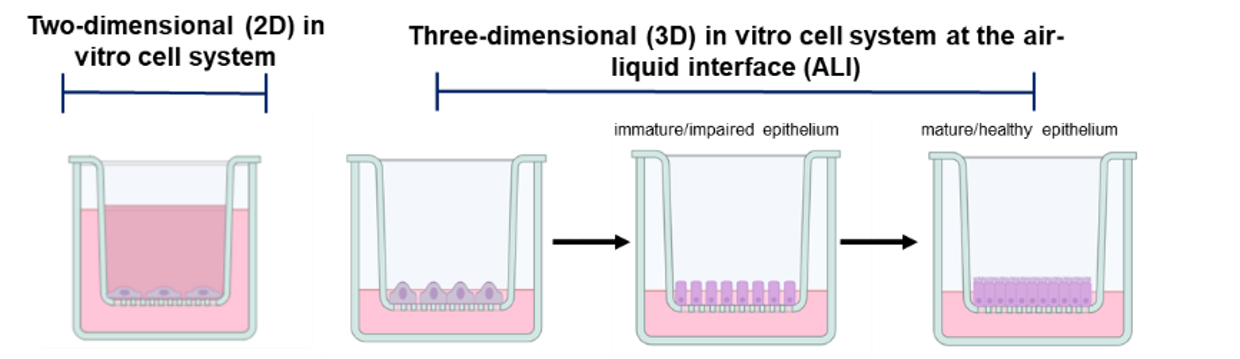
Figure 1
The platform is also integrated with a system for the controlled generation of environmental or experimental aerosols, expanding exposure capabilities to gaseous compounds, particulates, or complex mixtures. For this purpose, a set of instruments from TSI Incorporated (USA) is employed. Using an Electrostatic Classifier 3082, the aerosol generator (model 3740A) extracts monodisperse particles of a narrow size range from the polydisperse aerosol produced by an atomizer (model 3076). This atomizer enables stable and reliable generation of polydisperse aerosols, suitable for a wide range of applications. Aerosols are produced from solutions prepared in water or alcohols; solvents are typically removed from the sample stream using a diffusion dryer (model 3062). The Electrostatic Classifier 3082 provides high-resolution classification of submicron particles. These instruments are widely used across various research domains due to their high reliability and versatility. Finally, a Differential Mobility Analyzer (DMA) allows the selection of a single particle size class within a specific diameter range, while a Condensation Particle Counter (CPC) provides particle count statistics, including at low concentrations.
The in vitro exposure system (Figure 4) comprises a thermostatically controlled incubator and modular exposure chambers, enabling the controlled exposure of cells to low-flow aerosols while ensuring gentle and uniform sample application.
The incubator (Körber, Germany) has the following dimensions: 40 cm wide × 65 cm deep × 40 cm high. It houses two exposure chambers for cell culture, manufactured by Curbridge Engineering Ltd. (Thorne & Adamson, Exp Toxicol Pathol. 2013). Each chamber can accommodate up to 12 inserts for air-liquid interface (ALI) cell cultures, positioned to receive direct exposure to the tested substances.
Typically, the module is configured with at least three compartments for exposure to test substances and three control compartments with clean air, allowing for a direct comparison between treated and control conditions. The system is fully modular and expandable, allowing exposure to different concentrations of test substances in each module, thus facilitating the generation of complete concentration–response profiles within a single experiment.
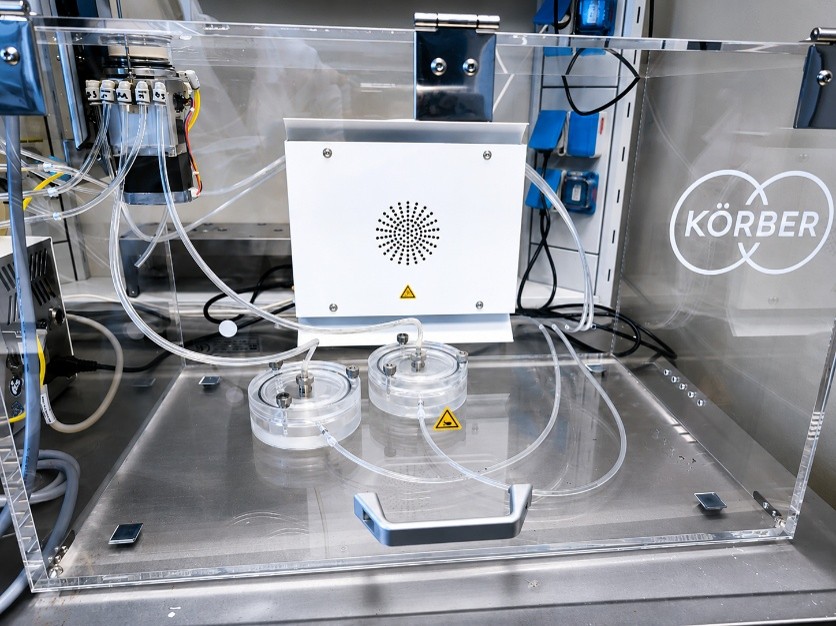
Figure 4
The Körber LM5E vaping machine is a high-tech instrument designed for collecting aerosols from all types of electronic cigarettes, vaporizers, and heated tobacco products (HTPs) (Figure 2).
It is equipped with the high-performance PM1 piston unit. A pre-installed software enables full control of the analytical process, from sample registration and data acquisition to automatic generation of trend graphs. The integrated Ethernet interface allows direct data transfer to an external PC.
The adjustable vaping bar includes five ports with adaptable supports, ensuring compatibility with devices of any size or format. It enables aerosol collection at variable angles, up to ±60° relative to the horizontal. All puffing parameters (volume, duration, frequency, and puffing profile) can be configured, either by selection from standardized settings (ISO 20768 or CRM 81) or by customizing them to meet specific experimental requirements, with the option to save them as user-defined regimes.
The automatic activation system is highly flexible and supports puff-synchronous activation, pre-puff, post-puff, child-safety unlocking, and pre-heating, making it compatible with new generation products (NGPs). The visible-button design enables real-time activation monitoring and provides easy access to samples, due to the 105 mm spacing between ports.
The LM5E is compatible with multiple aerosol collection systems, including Cambridge filter holders (44, 55, and 92 mm), impinger sets, and electrostatic precipitators—the latter being ideal for heavy metal quantification (Figure 3).
Finally, the LM5E can be easily integrated with exposure systems for in vitro toxicological testing, and it is also available in configurations with sample dilution. With a compact footprint (only 0.47 m²), it represents a complete, precise, and versatile solution for research and analysis of new-generation inhalation products
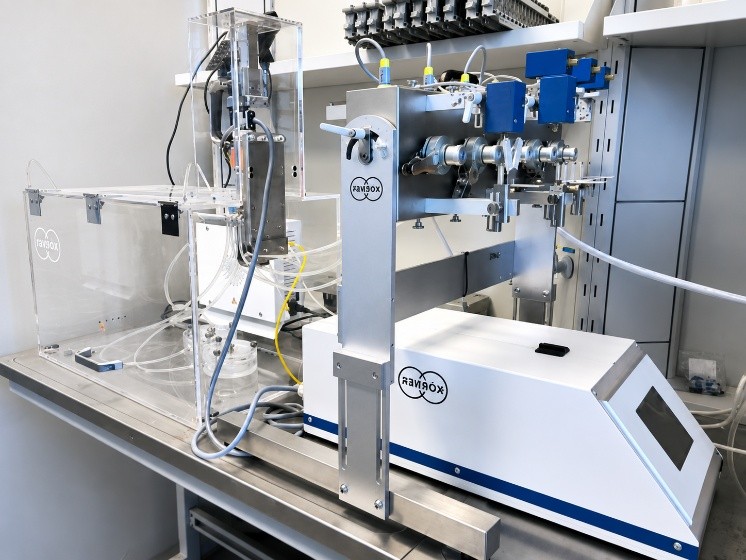
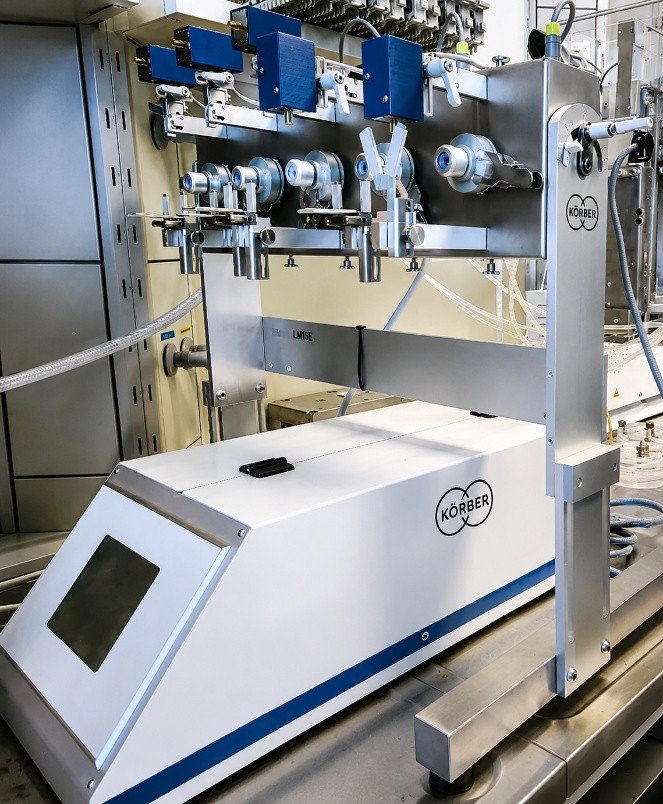
Figure 2 Figure 3
The in vitro exposure system (Figure 4) comprises a thermostatically controlled incubator and modular exposure chambers, enabling the controlled exposure of cells to low-flow aerosols while ensuring gentle and uniform sample application.
The incubator (Körber, Germany) has the following dimensions: 40 cm wide × 65 cm deep × 40 cm high. It houses two exposure chambers for cell culture, manufactured by Curbridge Engineering Ltd. (Thorne & Adamson, Exp Toxicol Pathol. 2013). Each chamber can accommodate up to 12 inserts for air-liquid interface (ALI) cell cultures, positioned to receive direct exposure to the tested substances.
Typically, the module is configured with at least three compartments for exposure to test substances and three control compartments with clean air, allowing for a direct comparison between treated and control conditions. The system is fully modular and expandable, allowing exposure to different concentrations of test substances in each module, thus facilitating the generation of complete concentration–response profiles within a single experiment
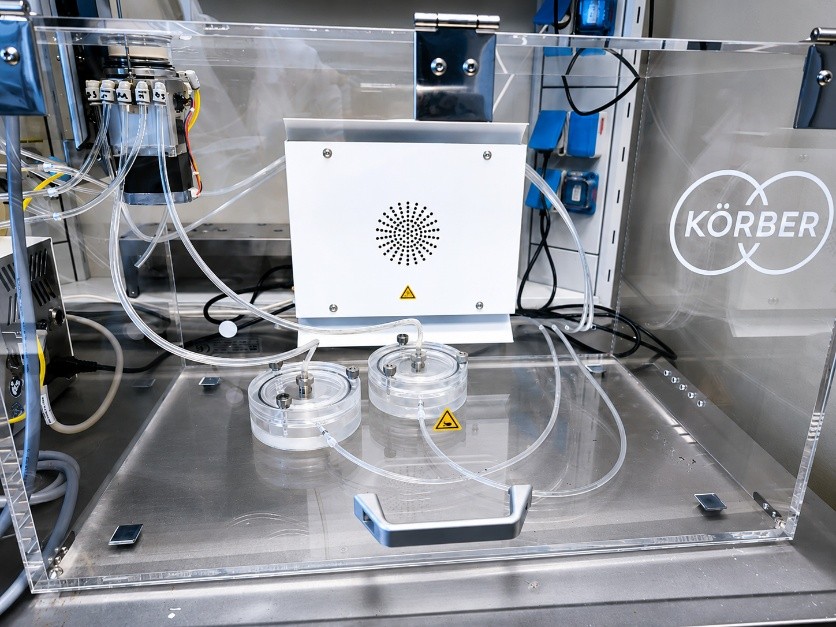
Figure 4
<p>The Submicrometer Monodisperse Aerosol Generator (model 3940A) includes all the necessary components to generate submicrometer, monodisperse aerosol particles. Briefly, the modular model 3940A enables the generation and subsequent size selection of particulate matter within a range of 0.01 to 1.0 µm. The full aerosol generation process consists of the following sequential stages (see Figure 1):</p><ol><li>Filtered Air Supply System (model 3074B), prepares the compressed air available from the CAST facility infrastructure, conditioning it to be suitable for aerosol generation.</li><li>Constant Output Atomizer (model 3076), produces aerosol from a solution or suspension by generating fine droplets with consistent output.</li><li>Diffusion Dryer (model 3062), removes solvents (typically water) from the droplets exiting the atomizer, resulting in dry aerosol particles.</li><li>Neutralizer (model 3012), brings the aerosol to a near-neutral charge distribution, centering the net charge around zero and rendering most particles electrically neutral.</li><li>Electrostatic Classifier (model 3082), Aerosol Neutralizer (model 3077A), and Differential Mobility Analyzer, DMA (model 3081A), receive the polydisperse aerosol from the upstream components and selectively emit particles of the desired size.<br />This classification process relies on the electrical mobility of charged particles (utilizing the remaining fraction of charged ones) to determine and isolate particles within a narrow, monodisperse size range.</li></ol><p>Figure 5 shows the schematic illustration of the aerosol generator (model 3940A) used at the Facility of Vaping and Aerosol Technologies</p><p> </p><p> </p><p> </p><p> </p><p> </p>
Due to the high specificity of the instrumentation, each application requires the collaboration of specialized facility staff, who possess the necessary expertise to operate the sophisticated equipment and to develop its applications.


Eleonora Aruffo
Associate Professor

Cristina Milillo
University Scientific and Technical Specialist